
Back to Overview

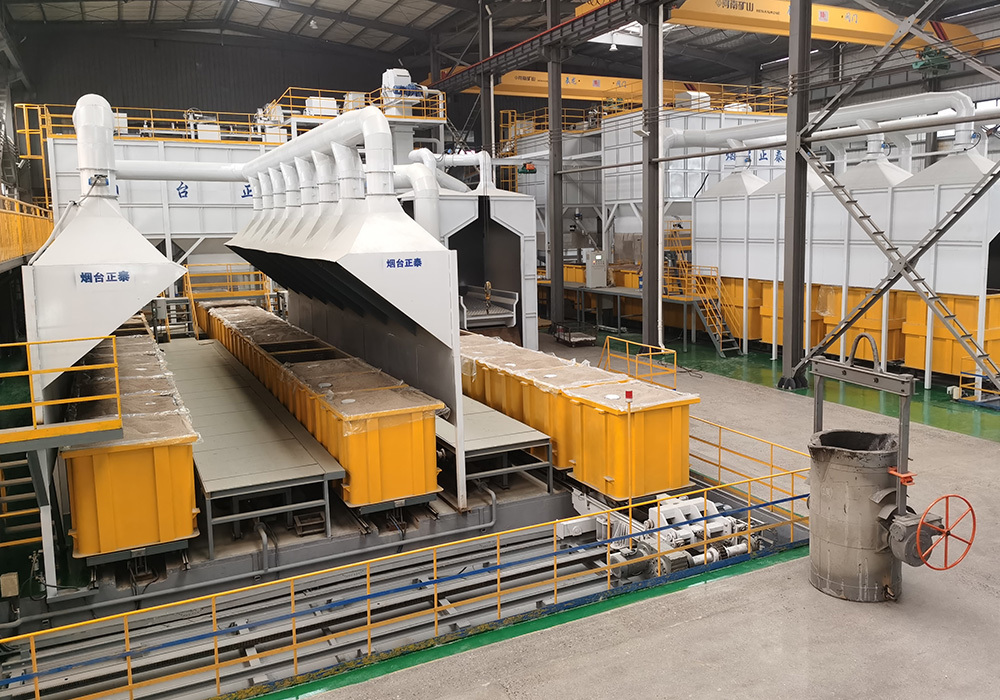
Let's take a look at the introduction of the lost foam production line and the spare parts of the lost foam casting equipment, and explore their powerful functions

Introduction to lost foam production line: Working pressure lost foam casting is a new casting technology that combines lost foam casting with pressure solidification crystallization technology.

Let's take a look at the powerful functions of spare parts for lost foam casting equipment, as introduced in the lost foam production line:

1. Working pressure lost foam casting

Introduction to lost foam production line: Working pressure lost foam casting is a new casting technology that combines lost foam casting with pressure solidification crystallization technology.

It refers to a casting method in which, after pouring molten metal into a sandbox pressure tank to vaporize and eliminate plastic foam, the pressure tank is sealed tightly, and gas under the necessary working pressure of the foam-purchasing machinery is introduced, causing the molten metal to solidify and crystallize under pressure. The characteristic of this casting technique is that it can significantly reduce casting defects such as shrinkage porosity, casting defects, and gas holes in the castings, improve the compactness of the castings, and enhance the structural mechanical properties of the castings.


2. Vacuum pump low voltage lost foam casting

Introduction to lost foam production line: Vacuum pump low-voltage lost foam casting is a new casting technique that combines the negative pressure lost foam casting method with the low-voltage gravity pouring method.

The characteristic of vacuum pump low-voltage lost foam casting technology is that it combines the advantages of low-voltage casting and vacuum pump lost foam casting technology. It can complete the filling process under the controlled standard pressure of lost foam casting machinery and equipment, greatly improving the casting filling ability of aluminum alloy. Compared with aluminum die casting, the machinery and equipment investment is small, the casting cost is low, and the castings can be strengthened by heat treatment process. Compared with sand mold casting, the castings have high precision, small surface roughness, high productivity, and good performance. Under the action of gravity, the straight sprue becomes a safety channel, the loss of pouring ambient temperature is small, and the liquid aluminum alloy undergoes shrinkage and solidification under controllable pressure. The pouring management system of aluminum alloy castings is simple and reasonable, with high output and high distribution density. The pouring temperature of vacuum pump low-voltage lost foam casting is low, suitable for a wide range of non-ferrous aluminum alloy plates.

3. Oscillation-free mold casting skills

Vibration-assisted lost foam casting involves adding vibrations of a certain frequency and amplitude during the lost foam casting process, allowing the casting to solidify under the actual effect of the oscillating field. Due to the constant vibration added to the aqueous solution of metal materials during the solidification process of lost foam casting, the oscillating force causes the high-efficiency liquid phase and solid phases to move at a relative speed, thereby crushing twin crystals and enhancing the key to crystallization within the high-efficiency liquid phase. This results in optimized solidification distribution, shrinkage development, and improved structural mechanics effects in the casting. This technique utilizes an existing compact oscillating table in lost foam casting, which generates mechanical vibration through an oscillating motor, enabling the molten metal to nucleate under dynamic support, achieving the purpose of optimized distribution. It is a practical, simple, cost-effective, and environmentally friendly method.

4. Semi-solid lost foam casting

Semi-solid lost foam casting is a new casting technology that combines lost foam casting with semi-solid technology. Due to the characteristics of this process, which depend on the relative market share of liquid and solid, it is also known as modified semi-solid molding. This technology can improve the compactness of castings, reduce shrinkage porosity, enhance dimensional accuracy, and improve casting performance.


Embrace customers from all over the world !

If you have any questions, you can leave us a message !
